
Employment Law Changes in April 2026: What Employers Need to Know
Is your business ready for Employment Law changes coming in April?
A range of Employment Law changes will come into force in April 2026, impacting employers across the UK. While many of these changes arise from the Employment Rights Act 2025 (ERA), others are being introduced through separate legislation.
At Alpha HR, we’ve summarised key developments and outlined what businesses need to do to ensure their workplace is prepared and compliant.
1st April 2026
Statutory Rates
National Minimum Wage
The national minimum wage increases will come into force on 1 April 2026, bringing changes that will impact employers and employees alike.

Other Statutory Rate Increases
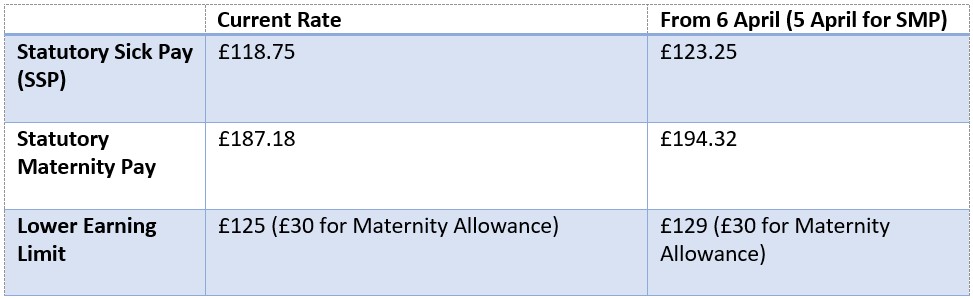
From 6 April 2026 (5 April for Statutory Maternity Pay), other statutory payments will also increase:
6 April 2026
Day-One Rights
Following the changes introduced by the Employment Rights Act 2025, employees will be entitled to day-one rights to paternity leave and parental leave from 6 April 2026.
Currently employees must have one year’s service to qualify for parental leave and 26 weeks for paternity leave. From 6 April 2026, these qualifying periods will be removed.
The paternity leave change will apply to babies born on or after 6 April 2026 (or earlier when the Expected Week of Childbirth stars on or after 5 April). However, there is no change to the eligibility requirement for paternity leave pay, and the leave will still be unpaid if the employee does not have 26 weeks’ service.
Employers should review and update their Family Leave Policies ahead of the changes.
Day One Statutory Sick Pay (SSP)
From 6 April 2026, Statutory Sick Pay will become payable from day one of sickness absence, removing the current three-day waiting period. In addition, the Lower Earnings Limit will be removed.
SPP with be payable at either the flat weekly rate or 80% of an employee’s normal weekly earnings, whichever is lower.
Paternity Leave for Bereaved Partners
A new statutory entitlement will come into force from 6 April 2026, allowing bereaved partners to take up to 52 weeks’ leave where the child’s mother or adopter dies within the first year following birth or adoption. This is a day-one right with no minimum period of service.
Notice requirements will vary depending on when leave is taken:
- Within 8 weeks of bereavement
- After 8 weeks, when at least a week’s notice is required
There is no statutory requirement for this leave to be paid, although employers may choose to enhance this in line with any existing family leave policies.
Record Keeping
From 6th April 2026 a new duty will be placed on employers to keep records of annual leave and holiday pay. This must include
- Annual leave taken
- Annual leave carried over from previous years
- Holiday pay
- Payments in lieu of holiday
This data must be kept for a minimum of 6 years and be kept in line with UK GDPR requirements.
Collective Redundancy Protective Award
From 6 April 2026, the maximum protective award for failing to comply with collective redundancy consultation requirements will increase significantly, from 90 to 180 days.
This applies where an employer fails to properly consult when proposing 20 or more redundancies.
Whistleblowing Protection
From 6 April 2026, sexual harassment will be recognised as ‘qualifying disclosures’ under whistleblowing legislation further to changes under the ERA.
This means protection from detriment and unfair dismissal for whistleblowers making a sexual harassment disclosure, i.e. a report that sexual harassment has occurred, is occurring or is likely to occur.
Simplification of Trade Union Recognition
Changes under the Employment Rights Act 2025 will simplify the statutory process for trade union recognition, making it easier for unions to gain a foothold in the workplace.
One key reform gives the government the power to lower the percentage of union membership required for the Central Arbitration Committee (CAC) to accept a recognition application. This threshold could be reduced from the current 10% to as low as 2%.
In addition, unions will no longer need to demonstrate likely majority support at the application stage, and the existing requirement for at least 40% of the workforce to vote in favour during recognition ballots will be removed.
7 April 2026
Fair Work Agency
The Fair Work Agency (FWA) is expected to be established on 7 April 2026 within the Department for Business and Trade, to bring together existing enforcement bodies, to enforce employment laws including National Minimum Wage, SSP, holiday pay and agency worker regulations.
It will have the power to inspect business premises and documentation, and issue civil penalties.
Next Steps for Employers
Employers should proactively prepare for the upcoming changes coming into fore. At Alpha HR, we provide practical, bespoke advice to businesses across the Uk who trust us to support their HR needs.
We have many options you could benefit from including “Alpha”, our national HR support service providing you with a dedicated advisor and a unique “partnership approach” supporting your business HR needs.
If you would like to discuss the process, please contact the Alpha team alpha@martinkaye.co.uk or 0845 450 1561